The painting portrays the Gog and Magog soldiers carrying lulavs or sporting Sukka head gear in a very unconventional and disrespectful way, as they are being defeated by G-d’s descending rain, fire and brimstone. The armies consist of Assyrians, Egyptians, German Nazis and other historical enemies of Israel, who in the end of days after their defeat march toward Jerusalem to celebrate Sukkoth. The images of Gog and Magog goose-step marching soldiers have been inspired by the archeologically excavated victory Stele of Naram-Sin (Akkad, 2159-2133 B.C.). Thank you http://www.nahumhalevi.com/sukkot.html Email nmosk @nahumhalevi.com.
 Sukkot and Simchat Torah
A great explanation on the celebration marking the conclusion of the annual cycle of public Torah readings, and the beginning of a new cycle. Simchat Torah is a component of the Biblical Jewish holiday of Shemini Atzeret ("Eighth Day of Assembly"), which follows immediately after the festival of Sukkot in the month of Tishrei (mid-September to early October on the Gregorian calendar).
The Final Days of Sukkot:
Shemini Atzeret & Simchat Torah
Shemini Atzeret 2010: Wednesday September 29
Simchat Torah 2010: Thursday September 30
Sukkot, the nine-day Festival of Booths, concludes with a special two-day holiday. The first of these days is known as Shemini Atzeret, meaning "the eighth day of assembly", and the final day is Simchat Torah, meaning "the joy of Torah". This joyful time has a number of special traditions associated with it, including:
Tefilat HaGeshem
Sukkot marks the conclusion of the harvest in Israel, and Shemini Atzeret welcomes in the beginning of the rainy season. In synagogue, a special prayer for rain, known as Tefilat Geshem, is recited.
Hakafot
In synagogue, Jews consecutively read aloud a portion of the Torah (Five Books of Moses) every week, reading the entire holy book each year. On Simchat Torah, the final passage of the Torah is read, immediately followed by the first passage, creating an unbroken cycle of Torah. To celebrate this auspicious and joyful occasion, worshippers participate in processions known as Hakafot. During these hakafot, people joyfully dance and sing while carrying the Torah scrolls.
Aliyot
An aliyah is a special honor in which members of the synagogue are called up to bless the Torah before it is reading. Typically there are seven aliyot during the reading of the Torah portion; on Simchat Torah, however, synagogues will repeat the readings over and over again, giving as many people as possible the opportunity to be honored by reciting these blessings.
Sitting in the Sukkah
Throughout the week, Jews traditionally eat their meals in the sukkah. Some even sleep there! During the final days of Sukkot, one is not obligated to eat in the sukkah. If one does eat in the sukkah on Shemenei Atzeret, he or she is not required to say the traditional blessing over sitting the sukkah.
Shemini Atzeret & Simchat Torah in Israel
In the Diaspora, Jews celebrate two separate, but attached days at the end of the Sukkot holiday: Shemini Atzeret and Simchat Torah. In Israel, however, there is only a one-day holiday at the end of Sukkot, and the traditions of both Simchat Torah and Shemini Atzeret are combined into this day. Thank you http://www.holidays.net/sukkot/simchat_torah.htm
 The Four Species (Hebrew: ארבעת המינים, Arba'at Ha-Minim, also called Arba Minim) are three types of branches and one type of fruit which are held together and waved in a special ceremony during the Jewish holiday of Sukkot. The waving of the Four Species is a mitzvah prescribed by the Torah, and contains symbolic allusions to a Jew's service of God.
The Four Species are:
* Lulav (לולב) – a ripe, green, closed frond from a date palm tree
* Hadass (הדס) – boughs with leaves from the myrtle tree
* Aravah (ערבה) – branches with leaves from the willow tree
* Etrog (אתרוג) – the fruit of a citron tree
Practice
The mitzvah of waving the Four Species derives from the Torah. In Leviticus, it states: “And you shall take for yourselves on the first day [of Sukkot], the fruit of the beautiful [citron] tree, tightly bound branches of date palms, the branch of the braided [myrtle] tree, and willows of the brook, and you shall rejoice before the Lord your God seven days.”[1] During the time of the Temple in Jerusalem, the waving ceremony (called na'anu'im – נענועים) was performed in the Holy Temple on all seven days of Sukkot, and elsewhere only on the first day. Following the destruction of the Temple, Rabbi Yohanan ben Zakkai ordered that the Four Species be waved everywhere on every day of Sukkot (except on Shabbat), as a memorial to the Temple.
To prepare the species for the mitzvah, the lulav is first bound together with the hadass and aravah (this bundle is also referred to as "the lulav") in the following manner: One lulav is placed in the center, two aravah branches are placed to the left, and three hadass boughs are placed to the right. (This order is the same for both right-handed and left-handed people.[2]) The bundle may be bound with strips from another palm frond, or be placed in a special holder which is also woven from palm fronds.
Sephardic Jews place one aravah to the right of the lulav and the second aravah to its left, and cover them with the three hadass boughs—one on the right, the second on the left, and the third atop the lulav's spine, leaning slightly to the right. The bundle is held together with rings made from strips of palm fronds. Many Hasidic Ashkenazi Jews follow this practice as well.
In all cases, all of the species must be placed in the direction in which they grew. (For the etrog, this means that the stem end should be on the bottom and the blossom end on top; this is the direction in which the etrog begins to grow, though as it matures on the tree it usually hangs in the opposite direction.)
 Reciting the blessing The waving the Four Species during Hallele Four Species during Hallel
To recite the blessing over the lulav and etrog, the lulav is held in one hand and the etrog in the other. Right-handed users hold the lulav in the right hand and the etrog in the left. The customs for those who are left-handed differ for Ashkenazim and Sephardim. According to the Ashkenazi custom, the lulav is held in the left hand, and according to the Sephardi custom, in the right hand.[3]
According to Sephardi custom, the blessing is said while holding only the lulav and the etrog is picked up once the blessing is completed. According to Ashkenazi custom, before the blessing is said, the etrog is turned upside-down, opposite the direction in which it grows. The reason for these two customs is that the blessing must precede the performance of the mitzvah. Should all the species be held in the direction in which they grew, the mitzvah would be fulfilled before the blessing is recited.
After reciting the blessing, "Blessed are You, Lord our God, King of the universe, Who has sanctified us with His commandments, and commanded us to take the lulav" (the "Shehecheyanu" blessing is also recited the first time each year that one waves the lulav and etrog), the etrog is turned right side up (or picked up), and the user brings his or her two hands together so that the etrog touches the lulav bundle. The Four Species are then pointed and gently shaken three times toward each of the four directions, plus up and down, to attest to God's mastery over all of creation.
The waving ceremony can be performed in the synagogue, or in the privacy of one's home or sukkah, as long as it is daytime. Women and girls may also choose to perform the mitzvah of waving the lulav and etrog, although they are not required by Halakha to do so. Because women are not required to perform this mitzva, some are of the opinion that Sephardi women do not need to recite the blessing. [1]
The waving is performed again (though without the attendant blessings) during morning prayer services in the synagogue, at several points during the recital of Hallel.
Additionally, in the synagogue, Hallel is followed by a further ceremony, in which the worshippers join in a processional around the sanctuary with their Four Species, while reciting special supplications (called hoshaanot, from the refrain hosha na, "save us"). From the first through the sixth day of Sukkot, one complete circuit is made; on Hoshanah Rabbah, the seventh and last day of Sukkot, seven complete circuits are made. As the Four Species are not used on Shabbat, there are variant customs as to whether hoshaanot are said and a circuit made on that day.
Selecting the Four Species: While all mitzvot should be performed in the best manner possible, hiddur mitzvah (beautifying the mitzvah) especially applies to the Four Species. The halacha is explicit on what constitutes the "best" in each species.[4] To that end, people will spend large amounts of money to acquire the most perfect etrog, the straightest lulav, and the freshest hadass and aravah. Usually a father will buy several sets of the Four Species to outfit his sons, as well. Another custom for hiddur mitzvah is to, depending on your custom of wrapping lulav and esrog, is to have more than two aravos and three haddasim. Some people have the custom to have as many as 40 extra haddassim and aravos.
Hiddur mitzvah applies to all mitzvot, but its absence does not impede the mitzvah from being performed. For the Four Species specifically, there is a further "technical" requirement of hadar (beauty), which does impede the mitzvah of the Four Species from being performed. Despite their similar names and details, these two requirements are distinct from one another. [2]
Symbolism: Several explanations are offered as to why these particular species were chosen for the mitzvah. The Midrash[5] notes that the binding of the Four Species symbolizes our desire to unite the four "types" of Jews in service of God. An allusion is made to whether or not the species (or their fruits) have taste and/or smell, which correspond to Torah and good deeds. The symbolism is as follows:
* The lulav has taste but no smell, symbolizing those who study Torah but do not possess good deeds.
* The hadass has a good smell but no taste, symbolizing those who possess good deeds but do not study Torah.
* The aravah has neither taste nor smell, symbolizing those who lack both Torah and good deeds.
* The etrog has both a good taste and a good smell, symbolizing those who have both Torah and good deeds.
A second explanation[6] finds the four species alluding to parts of the human body. Each of the species or its leaves is similar in shape to the following organs:
* Lulav – the spine
* Hadass – the eye
* Aravah – the mouth
* Etrog – the heart
By binding them together for a mitzvah, the Jew shows his desire to consecrate his entire being to service of God.
An additional reason for waving the Four Species in all directions alludes to the fact that all these species require much water to grow. The lulav (date palm) grows in watered valleys, hadass and aravah grow near water sources, and the etrog requires more water than other fruit trees. By taking these particular species and waving them in all directions, the Jew symbolically voices a prayer for abundant rainfall for all the vegetation of the earth in the coming year.
Other interpretations: The mitzvah is derived from the Book of Leviticus: "And you shall take for yourself on the first day the fruit of goodly (meaning of Hebrew uncertain, but modern Hebrew "citrus") trees, branches of palm trees, and boughs of thick trees, and willows of the brook" (Lev. 23:40). The use to which these species are to be put is not indicated; this gave rise to divergent interpretations at a later time. Two breakaway sects, the Sadducees and the Karaites, maintained that they were meant for building the sukkah, as would appear from Neh. 8:14-18, while their opponents contended that they were to be carried in the synagogue procession. http://encyclopedia.thefreedictionary.com/Four+Species

Sukkot
Sukkot (Hebrew: סוכות or סֻכּוֹת, sukkōt ; "booths", also known as Succoth, Sukkos, Feast of Booths or Feast of Tabernacles), is a Biblical pilgrimage festival that occurs in autumn on the 15th day of the month of Tishri (late September to late October). The holiday lasts 7 days. Outside the land of Israel, many people continue to sit in the Sukkah (temporary dwellings, the rainbow colors) on the following day, Shemini Atzeret. In Judaism it is one of the three major holidays known collectively as theShalosh Regalim (three pilgrim festivals), when historically the Jewish populace traveled to the Temple in Jerusalem.
The Three Pilgrimage Festivals, known as the Shalosh Regalim (שלוש רגלים), are three major festivals in Judaism — Pesach (Passover), Shavuot (Pentecost), and Sukkot (Tabernacles) — when the Israelites living in ancient Israel and Judea would make a pilgrimage to Jerusalem, as commanded by the Torah. In Jerusalem, they would participate in festivities and ritual worship in conjunction with the services of the kohanim ("priests") at the Temple in Jerusalem.
After the destruction of the Temple, the actual pilgrimage is no longer obligatory upon Jews, and no longer takes place on a national scale. During synagogue services the related passages describing the holiday being observed are read aloud from a Torah scroll on the Bimah (platform) used at the center of the synagogue services. During the Jewish holidays in modern-day Israel, many Jews living in or near Jerusalem make an effort to attend prayer services at the Western Wall "emulating" the ancient "pilgrimages" in some small fashion.
The Sukkah
The word Sukkot is derived from the Hebrew word sukkah, meaning booth or hut. During this holiday, Jews are instructed to build a temporary structure in which to eat their meals, entertain guests, relax, and even sleep. The sukkah is reminiscent of the type of huts in which the ancient Israelites dwelt during their 40 years of wandering in the desert after the Exodus from Egypt, and is intended to reflect God's benevolence in providing for all the Jews' needs in the desert.
The sukkah is a temporary structure used for meals throughout the holiday. Its walls can be made from any material, including wood, canvas, plaster or regular walls of glass or metal, but its roof must be of organic material that is detached from the ground. The decor of the interior of the sukkah may range from totally unornamented to lavishly decorated.
The Four Species
On each of the seven days of Sukkot, the Torah requires the Jew to take Four Species of plants and to grasp and shake them in a specific manner. These species are: the lulav (date palm frond),hadass (bough of a myrtle tree), aravah (willow branch)— these three are actually bound together and collectively referred to as the lulav—and the etrog (a citron, a lemon-like citrus fruit). These plants are usually sold in religious communities during the days preceding the festival. However, in some Reform communities where these plants are not available locally, other plants such as reeds are substituted for one or more of the four species.
 The Four Species are waved as follows: The first three species are held in the right hand, while thee trog is held in the left hand. The user holds his or her hands apart while saying the special blessing,"Blessed are You, God our Lord, King of the Universe, Who has sanctified us with His commandments and commanded us to take the lulav". Then the user brings his or her hands together so that the etrog touches the lulav bundle, and points and gently shakes the Four Species three times in each of the four directions, as well as up and down. Symbolically, this ceremony is a prayer for adequate rainfall for all the vegetation of the earth in the coming year.
In Orthodox circles, the mitzvah of waving the lulav and etrog is mandatory each day of Sukkot (except Shabbat) for men and boys over the age of bar mitzvah. Although women are not obligated to wave the lulav and etrog, they may do so if they choose, and traditionally, Orthodox women are considered to have taken the obligation upon themselves and perform it as their male counterparts. In Conservative and Reform circles, all Jews over the age of Bar or Bat Mitzvah perform the waving ceremony.
Sukkot laws and customs
In modern day Israel (and among Reform Jews), Sukkot is a 7-day holiday, with the first day celebrated as a full festival with special prayer services and holiday meals. Outside the land of Israel, the first two days are celebrated as full festivals. The remaining days are known as Chol HaMoed ("festival weekdays"). The seventh day of Sukkot is called Hoshanah Rabbah and has a special observance of its own.
Prayers
Prayers during Sukkot include the reading of the Torah every day, saying the Mussaf (additional) service during morning prayers, reading the Hallel and adding special supplications into the Amidah and grace after meals. On the first day of Sukkot (the first two days, outside of Israel), the prayer services are extended and similar to those of Shabbat. Hallel (Hebrew: הלל "Praise [God]" is part of Judaism's prayers, a verbatim recitation from Psalms 113-118, which is used for praise and thanksgiving that is recited by observant Jews on Jewish holidays. Hallel consists of six Psalms (113-118), which are said as a unit, on joyous occasions. It is usually chanted aloud as part of Shacharit (the morning prayer service) following the Shacharit's Shemoneh Esreh ("The Eighteen", the main prayer). It is also recited during the evening prayers the first night of Passover.) Psalms • תהילים (Tehilim)'' Psalm 23 • Psalm 51 • Psalm 67 • Psalm 74, Psalm 83 • Psalm 89 • Psalm 91 • Psalm 95,• Psalm 98 • Psalm 100 • Psalm 103,• Psalm 104 • Psalm 109 • Psalms 113-118 Psalm 119 • Psalm 130 • Psalm 137
• Psalm 151 • Psalms 152–155 Complete Psalms 1–150
Muktza
Many of the laws of Muktza that apply on Shabbat also apply on Sukkot, such as the prohibition of engaging in commerce, lighting a fire, and completing an electric circuit. Other Shabbat prohibitions, however, are relaxed. With various differences based on one's religious orientation, one is permitted to cook (so long as the fire is pre-existing), smoke (again, so long as the fire is pre-existing), and carry material things beyond the home or eruv boundaries ("an eruv" frequently refers to this symbolic "fence," (actually "doorframe/s") rather than the eruv itself. However, the term eruv actually refers to the process of sharing ownership within the enclosed domain.)
The relaxed rules derive from the specific tasks and duties that were permitted to be done on Sukkot in the Beit HaMikdash (Holy Temple) that were otherwise forbidden on Shabbat.
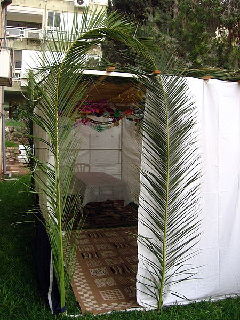
Sukkah in Herzliya
The applicable rules of Muktza only apply on the first day of Sukkot for those in Israel, and the first two days outside of Israel. For the remaining five days, known as Chol HaMoed (see below) other rituals are practiced, but Muktza does not apply.
General Concept of Muktza: Muktza is essentially a restriction on objects that were not 'prepared' before the Sabbath. The absence of prepairedness in this sense means that the vast majority of people would not expect to use this particaular item or substance on Shabbat.
Categories: There are four main categories of muktza, each one with different halakhic ramifications:
- Muktza Mahmat Gufo – An object or substance not designed or prepared for any use (sometimes referred to as not having a 'torat keli').
- Keli she'Melakhto le'Isur – An object that is used most of the time for activities prohibited on Shabbat (e.g. a pencil - writing is forbidden on Shabbat).
- Muktza Mahmat Hisaron Kis – An object that is a Keli she'Melakhto le'Isur and that the owner of which is strict not to use it in any other way for fear of potential damage (e.g. a guitar-its use is prohibited on Shabbat and most people would not use it as a stepping stool).
- Basis le-Davar he-Asur – an object on which a muktza object was placed before Shabbat (e.g. a table on which candlesticks were placed before Shabbat).
When the first day or Sukkot falls on Shabbat (or one of the first two days outside of Israel), the greater restrictions of Shabbat take effect. As a practical matter, on Shabbat, the rituals and blessings over the Four Species are not performed.
Chol HaMo'ed
The second through seventh days of Sukkot (third through seventh days outside the land of Israel) are called Chol HaMo'ed (חול המועד - lit. "festival weekdays"). These days are considered by Halakha to be more than regular weekdays but less than festival days. In practice, this means that all activities that are needed for the holiday—such as buying and preparing food, cleaning the house in honor of the holiday, or traveling to visit other people's sukkahs or on family outings—are permitted by Jewish law. Activities that will interfere with relaxation and enjoyment of the holiday—such as laundering, mending clothes, engaging in labor-intensive activities—are not permitted. Observant Jews typically treat Chol HaMo'ed as a vacation period, eating nicer than usual meals in their sukkah, entertaining guests, visiting other families in their sukkahs, and taking family outings.
On the Shabbat which falls during the week of Sukkot (in the event when the first day of Sukkot is on Shabbat, the Book of Ecclesiastes (seasons of time) is read read during morning synagogue services in Israel. (Diaspora communities read it the following Shabbat). This Book's emphasis on the ephemeralness of life ("Vanity of vanities, all is vanity...") echoes the theme of the sukkah, while its emphasis on death reflects the time of year in which Sukkot occurs (the "autumn" of life). The second to last verse reinforces the message that adherence to God and His Torah is the only worthwhile pursuit.
Halakha (Hebrew: הלכה ; alternate transliterations include Halocho and Halacha) is the collective body of Jewish religious law, including biblical law (the 613 mitzvot) and later talmudic and rabbinic law, as well as customs and traditions. Judaism classically draws no distinction in its laws between religious and ostensibly non-religious life. Hence, Halakha guides not only religious practices and beliefs, but numerous aspects of day-to-day life. Halakha is often translated as "Jewish Law," though a more literal translation might be "the path" or "the way of walking." The word is derived from the Hebrew root that means to go or walk.
Hakhel
In the days of the Temple in Jerusalem, all Jewish men, women, and children on pilgrimage to Jerusalem for the festival would gather in the Temple courtyard on the first day of Chol HaMo'ed Sukkot to hear the Jewish king read selections from the Torah. This ceremony, which was mandated in Deuteronomy 31:10-13, was held every seven years, in the year following the Shmita (Sabbatical) year. This ceremony was discontinued after the destruction of the Temple, but it has been revived by some groups and by the government of Israel on a smaller scale.
Deuteronomy (Greek deuteronomion, Δευτερονόμιον "second law") is the fifth book of the Hebrew Bible and of the Old Testament. In form it is a set of three sermons delivered by Moses reviewing the previous forty years of wandering in the wilderness; its central element is a detailed law-code by which the Children of Israel are to live in the Promised Land.
In theological terms the book constitutes a covenant between Yahweh, the God of Israel, and the "Children of Israel"; this is the culmination of the series of covenants which begins with that between Yahweh and all living things after the Flood (Genesis 9). One of its most significant verses constitutes the shema* ("Hear, O Israel, the Lord (YHWH) is our God, the Lord (YHWH) alone!"), which today serves as the definitive statement of Jewish identity.
The Children of Israel, Bani Israil (بني اسرائيل) in Arabic or B'nei Yisrael (בני ישראל) in Hebrew B'nai Yisrael, B'nei Yisroel or Bene Israel) is a Biblical term for the Israelites. It is also an alternate way of referring to the people known as Hebrews or Jews. In the Torah, the literal children of Israel are the twelve sons of Jacob (also named Israel). The Children of Israel are also known as the Twelve Tribes. (also The phrase "Children of Israel" (or "Sons of Israel") refers to the offspring of the Biblical patriarch Jacob, who was renamed "Israel" after he triumphed in a wrestling match with a mysterious adversary. The name "Israel" in English means "Struggles with God". Jacob's twelve sons were the progenitors of the biblical Twelve Tribes of Israel. The Torah refers to them alternatively as the "children of Jacob" and the "children of Israel." After their descendants multiplied during their exile in ancient Egypt, the Bible continues to refer to them as the "Children of Israel."
*Shema Yisrael (or Sh'ma Yisroel or just Shema) (Hebrew: שמע ישראל; "Hear, [O] Israel") are the first two words of a section of the Torah (Hebrew Bible) that is used as a centerpiece of all morning and evening Jewish prayer services and closely echoes the monotheistic message of Judaism. It is considered the most important prayer in Judaism, and its twice-daily recitation is a mitzvah (religious commandment).
The term "Shema" is used by extension to the whole part of the daily prayers that commences with Shema Yisrael and comprises Deuteronomy 6:4–9, 11:13-21, and Numbers 15:37–41 These are in the weekly Torah portions: Eikev, VaEtchannan, and Shlach respectively.
 History: Originally, the Shema consisted only of one verse: Deuteronomy 6:4 (see Talmud Sukkot 42a and Berachot 13b). The recitation of the Shema in the liturgy, however, consists of three portions: Deuteronomy 6:4–9, 11:13–21, and Numbers 15:37–41. These three portions relate to central issues of Jewish belief.
Additionally, the Talmud points out that subtle references to the Ten Commandments can be found in the three portions. As the Ten Commandments were removed from daily prayer in the Mishnaic period, the Shema is seen as an opportunity to commemorate the Ten Commandments.
The Hebrew text of the first two paragraphs of the Shema, as they are written on a mezuzah:
Notice that the two larger-print letters in the first sentence ('ayin ע and daleth ד) spell "עד" which in Hebrew means "witness". The idea thus conveyed is that through the recitation or proclamation of the Shema' one is a living witness testifying to the truth of its message. Modern Kabbalistic schools, namely that of the ARI, teach that when one recites the last letter of the word 'echadh' (אחד), meaning "one", he/she is to 'intend that he is ready to "die into God".
Shema Yisrael: The first, pivotal, words of the Shema are:
שמע ישראל יהוה אלהינו יהוה אחד
Judaism teaches that the Tetragrammaton (י-ה-ו-ה) is the ineffable name of God, and as such is not read aloud in the Shema but is traditionally replaced with אדני, Adonai ("my Lord"). For this reason, the Shema is recited aloud as:
Shema Yisrael Adonai Eloheinu Adonai Echad.
The literal word meanings are roughly as follows:
Shema (A three part word) — listen, or hear and "act on"
Yisrael — Israel, in the sense of the people or congregation of Israel
Adonai — often translated as "Lord", it is used in place of the Tetragrammaton
Eloheinu — our God, the word "El" or "Elohei" signifying God (see also: Elohim), and the plural possessive determiner suffix "nu" or "einu" signifying "our"
Echad — the Hebrew word for "1" (the number)
In common with many other ancient languages, connective words such as "is", and conventions regarding punctuation, are usually implied rather than stated as they would be in modern English.
The first portion relates to the issue of the kingship of God. The first verse, "Hear, O Israel: the Lord our God is one Lord," has ever been regarded as the confession of belief in the One God. Due to the ambiguities of the Hebrew language there are multiple ways of translating the Shema:
"Hear, O Israel! The LORD is our God! The LORD is One!" and,
"Hear, O Israel! The LORD is our God — the LORD alone."
Many commentaries have been written about the subtle differences between the translations. There is an emphasis on the oneness of God and on the sole worship of God by Israel. There are other translations, though most retain one or the other emphases.
V'ahavta

V'ahavta in Hebrew: The following verses, commonly referred to by the first word of the verse immediately following the Shema as the V'ahavta, meaning "And you shall love...", contain the commands to love God with all one's heart, soul, and might; to remember all commandments and "teach them diligently to your children and speak of them when you sit down and when you walk, when you lie down and when you rise" (Deut 6:7); to recite the words of God when retiring or rising; to bind those words "on thy arm and thy head" (interpreted as tefillin), and to inscribe them on the door-posts of your house and on your gates (referring to mezuzah).V'haya im shemoa: The passage following the "Shema" and "V'ahavta" relates to the issue of reward and punishment. It contains the promise of reward for serving God with all one's heart, soul, and might (Deut 11:13) and for the fulfillment of the laws. It also contains punishment for transgression. It also contains a repetition of the contents of the first portion -but this time spoken to the second person plural, (Where as the first portion is directed to the individual Jew, this time it is directed to the whole community, all the Jews).
Vayomer: The third portion relates to the issue of redemption. Specifically, it contains the law concerning the tzitzit as a reminder that all laws of God are obeyed, as a warning against following evil inclinations and in remembrance of the exodus from Egypt. For the prophets and rabbis, the exodus from Egypt is paradigmatic of Jewish faith that God redeems from all forms of foreign domination. It can be found in the portion "Shlach Lecha" in the book of Numbers.
Summary of V'ahavta: In summary, the content flows from the assertion of the oneness of God's kingship. Thus, in the first portion, there is a command to love God with all one's heart, soul and might and to remember and teach these very important words to the children throughout the day. Obeying these commands, says the second portion, will lead to rewards, and disobeying them will lead to punishment. To ensure fulfillment of these key commands, God also commands in the third portion a practical reminder, wearing the tzitzit, "that ye may remember and do all my commandments, and be holy unto your God."
The full content verse by verse, in Hebrew, English transliteration and English translation, can be found here.
The second line quoted, "Blessed be the Name of His glorious kingdom for ever and ever", was originally a congregational response to the declaration of the Oneness of God; it is therefore often printed in small font and recited in an undertone, as recognition that it is not, itself, a part of the cited Biblical verses. The third section of the Shema formally ends at Numbers 15:41, but in fact traditionally Jews end the recitation of the Shema (Shema means "what is", in Chinese, or what is truth, knowledge, the way of the torah) with the following word from the next verse, Emet, or "Truth", as the end of the prayer.
Recitation and reading: The Hebrew Bible states that "these words" be spoken of "when you lie down, and when you rise up" Deuteronomy 6:7.
The first book of the Talmud, tractate Brachot, opens with a discussion of when exactly the Shema needs to be recited. The Mishna connects the time of recitation with details of the rhythm of the life of the Temple in Jerusalem, saying that the Shema should be recited in the evening when the Kohanim (Jewish priests) who were Tamei (ritually impure) (and had been unable to serve) enter to eat their Terumah (heave offerings). The Gemarrah contains a wide-ranging discussion of exactly when this occurred, with general agreement that it occurred in the evening, either after sunset or after three stars were visible. A similar discussion describes the morning Shema, which can be recited at first light prior to sunrise, as soon as colors can be discerned.
The Shema does not have to be recited in Hebrew. It may be recited in any language the worshipper understands (Berakhot 2:3). However, it is an almost universal custom among observant Jews to recite it in Hebrew.
In Orthodox and Conservative Judaism, the Shema should be recited twice daily, whether or not one is able to attend services with a congregation, wherever one is. Even a requirement of decent surroundings (e.g. not to recite it in the bathroom) can be waived if necessary, as occurred for example at Auschwitz.
The Shema, or as much of the first verse of it as can be said under the circumstances, is traditionally recited by a dying person as part of an affirmation of faith upon death. It is also recited at the end of Ne'illah service on Yom Kippur.
Women and the Shema: In Orthodox Judaism, women are not required to recite the Shema, as with other time-bound requirements which might impinge on their traditional familial obligations, although they are obligated to pray at least once daily without a specific liturgy requirement and many discharge that obligation through prayers like the Shema. Since 2002, Conservative Judaism has regarded Conservative women as generally obligated to recite the Shema at the same times as men. Reform Judaism and Reconstructionist Judaism do not regard gender-related traditional Jewish ritual requirements, including obligations for men but not women to pray specific prayers at specific times, as necessary in modern circumstances; instead, both genders may fulfill all requirements.

Accompanying blessings: The Benedictions preceding and following the Shema are traditionally credited to the members of the Great Assembly. They were first instituted in the liturgy of the Temple in Jerusalem.
According to the Talmud, the reading of the Shema morning and evening fulfils the commandment "You shall meditate therein day and night". As soon as a child begins to speak, his father is directed to teach him the verse "Moses commanded us a law, even the inheritance of the congregation of Jacob" (Deut. 33:4), and teach him to read the Shema (Talmud, Sukkot 42a). The reciting of the first verse of the Shema is called "the acceptance of the yoke of the kingship of God" (kabalat ol malchut shamayim) (Mishnah Berachot 2:5). Judah ha-Nasi, who spent all day involved with his studies and teaching, said just the first verse of the Shema in the morning (Talmud Berachot 13b) "as he passed his hands over his eyes" which appears to be the origin of the Jewish custom to cover the eyes with the right hand whilst reciting the first verse.
The first verse of the Shema is recited aloud, simultaneously by the hazzan and the congregation, which responds with the rabbinically instituted Baruch Shem ("Blessed be the Name") in silence before continuing the rest of Shema. Only on Yom Kippur is this response said aloud. The remainder of the Shema is read in silence. Sephardim recite the whole of the Shema aloud, except the Baruch Shem. Reform Jews also recite the whole of the Shema aloud, but including the Baruch Shem.
Bedtime Shema: Before going to sleep, the first paragraph of the Shema is recited. This is not only a commandment directly given in the Bible (in Deuteronomy 6:6–7), but is also alluded to from verses such as "Commune with your own heart upon your bed" (Psalms 4:4).
Some also have the custom to read all three paragraphs, along with a whole list of sections from Psalms, Tachanun, and other prayers. altogether this is known as the Kerias Shema She'al Hamita. According to the Arizal, reading this prayer with great concentration is also effective in cleansing one from sin. This is discussed in the Tanya.[1]
Other instances: The exhortation by the Kohen ("priest") in calling Israel to arms against an enemy (which does not apply when the Temple in Jerusalem is not standing) also includes Shema Yisrael. (Deuteronomy 20:3; Talmud Sotah 42a).
Rabbi Akiva patiently endured while his flesh was being torn with iron combs, and died reciting the Shema. He pronounced the last word of the sentence, Echad ("one") with his last breath (Talmud Berachot 61b). Since then, it has been traditional for Jews to say the Shema as their last words.
Arnold Schoenberg used it as part of the story to his narrative orchestral work A Survivor from Warsaw (1947).
Roi Kline, a major in the IDF, said the Shema before jumping on a live grenade, in accordance with the traditional Jewish practice of reciting the Shema when one believes one is going to die.
In Parade (musical) (see [1]) the main character Leo Frank, wrongly accused of the murder of a child worker at the pencil factory he manages, recites the Shema Yisrael as a vigilante gang kidnap and hang him in the final scenes of the work. The musical is based on a true story.
Shema in Christianity: Shema is one of the sentences that are quoted in the New Testament. The Gospel of Mark 12:29 mentions that Jesus considered the Shema the beginning exhortation of the first of his two greatest commandments: "And Jesus answered him, The first of all the commandments is, 'Hear, O Israel; The Lord our God is one Lord'" (KJV). Jesus also refers to the Shema in The Gospel of John 10:30. A group of Jews in the Temple in Jerusalem at the Feast of Dedication, or Hanukkah, asks him if he is Messiah, the anointed one of God. Jesus concludes his response with the words "I and my Father are one" (KJV). This is an allusion to the Shema, which the Jews immediately recognize.
In addition, the apostle Paul reworks the Shema in 1 Corinthians 8:6 vis-à-vis the risen Christ: "yet for us there is one God, the Father, from whom are all things and for whom we exist, and one Lord, Jesus Christ, through whom are all things and through whom we exist."[2]
Simchat Beit HaSho'eivah
In the days of the Temple in Jerusalem, a unique service was performed every morning throughout the Sukkot holiday: the Nisuch HaMayim (נסוך המים—lit. "pouring of the water") or Water Libation Ceremony. According to the Talmud, Sukkot is the time of year in which God judges the world for rainfall; therefore this ceremony, like the taking of the Four Species, invokes God's blessing for rain in its proper time. The water for the libation ceremony was drawn from the Pool of Siloam (Hebrew: Breikhat Hashiloah in the City of David, believed to be the original site of Jerusalem, now outside the walls of the Old City to the southeast. The pool was fed by the waters of the Gihon Spring, which were carried there by two aquaducts - the Middle Bronze Age Channel, a 20ft deep direct cutting that was covered with rock slabs, and dates from the Middle Bronze Age Hezekiah's Tunnel, a curving tunnel within the bedrock, dating from the reign of King Hezekiah ~700BC, is a rock-cut pool on the southern slope of the ~1800BC) and the joy that accompanied this procedure was palpable. (This is the source for the verse in Isaiah: "And you shall draw waters with joy from the wells of salvation" (Isa. 12:3).
Afterwards, every night in the outer Temple courtyard, tens of thousands of spectators would gather to watch the Simchat Beit HaSho'eivah (Rejoicing at the Place of the Water-Drawing), as the most pious members of the community danced and sang songs of praise to God. The dancers would carry lighted torches, and were accompanied by the harps, lyres, cymbals and trumpets of the Levites. According to the (The Mishnah or Mishna (משנה, "repetition", from the verb shanah שנה, or "to study and review") is a major work of Rabbinic Judaism, and the first major redaction into written form of Jewish oral traditions, called the Oral Torah.) Mishna tractate Sukkah, "He who has not seen the rejoicing at the Place of the Water-Drawing has never seen rejoicing in his life." Throughout Sukkot, the city of Jerusalem teemed with Jewish families who came on the holiday pilgrimage and joined together for feasting and Torah study. A mechitza* (partition separating men and women) was erected for this occasion.
Nowadays, this event is recalled via a Simchat Beit HaSho'eivah gathering of music, dance, and refreshments. This event takes place in a central location such as a synagogue, yeshiva*, or place of study. Refreshments are served in the adjoining sukkah. Live bands often accompany the dancers. The festivities usually begin late in the evening, and can last long into the night.
*Mechitza: A mechitza (מחיצה, Hebrew: partition or division, plural mechitzot) is a partition that is a valid divider under Jewish law.
Origin: The rationale for a partition dividing men and women is given in the Babylonian Talmud (Sukkah 51b, 52a). A divider in the form of a balcony was established in the Temple in Jerusalem for the occasion of the Simchat Beit Hashoeivah (Water Drawing Ceremony) on Sukkot, a time of great celebration and festivity. The divider was first established to preserve modesty and attention during this time. In the Talmud, the Amoraic sage Abba Arika (known as Rav) explains that the divider originated with a statement of the prophet Zechariah regarding the mourning following the war between Gog and Magog (dark and light, heaven and earth, female and male):
The land will mourn each of the families by itself: the family of the house of David by itself, and their wives by themselves; the family of Nathan by itself and their wives by themselves; the family of the house of Levi by itself and their wives by themselves; the family of Shimei by itself and their wives by themselves; and all the families who remain, each of the families by itself and their wives by themselves. Zechariah 12:12-14. [1]
The rabbis of the Talmud reasoned that if such a sad occasion necessitates a separation between men and women, then the Simchat Beit HaShoeivah in the Temple in Jerusalem, considered the happiest Jewish occasion, does as well.
Uses of Separate seating in synagogue: A mechitza most commonly means the physical divider placed between the men's and women's sections in Orthodox synagogues and at religious celebrations. The idea behind this is twofold. First, mingling of the genders is generally frowned upon, as this leads to frivolity, which itself may lead to promiscuity. Secondly, even if the sexes are separated, they shouldn't be able to interact to a high degree during a religious service, lest this lead to gazing and impure thoughts. Because of these restrictions, mechitzot are usually opaque (at least looking from the men's side to the women's side). The women's section of the synagogue is called the Ezrat Nashim (women's courtyard) after a similar area in the Temple in Jerusalem.
*A yeshiva or yeshivah (IPA: [jəʃi'və]) (Hebrew: ישיבה, "sitting (n.)" ; pl. yeshivot or yeshivas) is a Jewish institution for Torah study and the study of Talmud. Yeshivot are usually Orthodox Jewish institutions, and generally cater to boys or men. A roughly equivalent women's institution is the midrasha.
The term yeshiva gedola ("senior/great yeshiva") refers to post-high school institutions, and yeshiva ketana ("junior/small yeshiva") refers to institutions catering to boys of high school age. The term "yeshiva" is also used sometimes as a generic name for any school that teaches Torah, Mishnah and Talmud, to any age group.
A yeshiva with a framework for independent study and providing stipends for male married students is known as a kollel.
Etymology: Jewish tradition holds that students should sit while learning from a master. The word yeshiva, meaning "sitting," therefore came to be applied to the activity of learning in class, and hence to a learning "session."
Academic year: In most yeshivot, the year is divided into three periods (terms) called zmanim. Elul zman starts from the beginning of the Hebrew month of Elul and extends until the end of Yom Kippur. This is the shortest (approx. six weeks), but most intense semester as it comes before the High Holidays of Rosh Hashanah and Yom Kippur.
Winter zman starts after Sukkot and lasts until just before Passover, a duration of five months (six in a Jewish leap year). Summer semester starts after Passover and lasts until either the middle of the month of Tammuz or Tisha B'Av, a duration of about three months. A typical beth midrash in Yeshivas Ner Yisroel in Baltimore. Usually each student has his own fixed place to sit, known as a makom kavuah.
Typical schedule: The following is a typical daily schedule for Beit Midrash students:
* 7:00 a.m. - Optional seder (study session)
* 7:30 a.m. - Morning prayers
* 8:30 a.m. - Session on study of Jewish law
* 9:00 a.m. - Breakfast
* 9:30 a.m. - Morning Talmud study (first seder)
* 12:30 p.m. - Shiur (lecture) - advanced students sometimes dispense with this lecture
* 1:30 p.m. - Lunch
* 2:45 p.m. - Mincha - afternoon prayers
* 3:00 p.m. - Mussar seder - Jewish ethics
* 3:30 p.m. - Talmud study (second seder)
* 7:00 p.m. - Dinner
* 8:00 p.m. - Night seder - Review of lecture, or study of choice.
* 9:25 p.m. - Mussar seder - Jewish Ethics
* 9:45 p.m. - Maariv - Evening prayers
* 10:00 p.m. - Optional evening seder
This schedule is generally maintained Sunday through Thursday. On Thursday nights there may be an extra long night seder, known as mishmar sometimes lasting beyond 1:00 am, and in some yeshivot even until the following sunrise. On Fridays there is usually at least one seder in the morning and the afternoons are free. Saturdays have a special Shabbat schedule which includes some sedarim but usually no shiur.
Method of study: Studying is usually done together with a study-partner called a chavruta (Aramaic: "friend"), or in a shiur (lecture). The chavruta is one of the unique features of the yeshiva. The young men studying in the yeshiva will spend most of their time with a study partner. The duo should read over the text, discuss it, test each other, ask questions, encourage each other etc. Upon entering the main study of the yeshiva, a first-time visitor will be amazed at the noise level. The learning partners in each chavruta will be almost shouting at each other, generating much noise.
Hoshanot
In the synagogue, each day of Sukkot, worshippers parade around the synagogue carrying theirlulavim and etrogim and reciting Psalm 118:25 (Anna, Adonay, hoshi'a na..", "We beseech you, O Lord, save us..." followed by special prayers). The Hoshanot are recited either after the morning's Torah reading of at the end of Mussaf. This ceremony commemorates the Aravah (willow) ceremony in the days of the Temple in Jerusalem, in which willow branches were piled beside the altar, with their tops branching over it, and worshipers paraded around the altar reciting the same verse.
Hoshanah Rabbah
The seventh day of Sukkot is known as Hoshanah Rabbah (הושענא רבא, Great Supplication). This day is marked by a special synagogue service, the Hoshanah Rabbah (Great Hoshanah), in which seven circuits are made by the worshippers with their lulav and etrog, while the congregation recites Psalm 118:25 and additional prayers. It is customary in some communities for all the scrolls of the Torah to be removed from the ark and lead this procession. In addition, a bundle of five aravah branches is taken and beaten against the ground, accompanied by a series of liturgical verses ending with, "Kol mevasser, mevasser ve-omer" (A voice brings news, brings news and says) —expressing hope for the speedy coming of the Messiah. The reasons for the latter custom are rooted in Kabbalah.
Abudarham speaks of the custom of reading the Torah on the night of Hoshanah Rabbah, out of which has grown the modern custom of meeting socially on that night and reading from Deuteronomy, Psalms, and passages from the Zohar; reciting Kabbalistic prayers; and eating refreshments. In Orthodox Jewish circles, men will stay up all night learning Torah.
Among Sephardic Jews, prayers known as "Selihot" (forgiveness) are recited before the regular morning service (these are the same prayers recited before Rosh Hashanah). In Amsterdam and in a few places in England, America, and elsewhere, the shofar (call of the mighty horn) is also sounded in connection with the processions. The latter practice reflects the idea that Hoshanah Rabbah is the end of the high holiday season, when the world is judged for the coming year.
Shemini Atzeret and Simchat Torah
The day immediately following Sukkot is known as Shemini Atzeret, "the Eighth (Day) of Assembly." Shemini Atzeret is a separate holiday.[1] In Israel, the celebration of Shemini Atzeretincludes Simchat Torah*. Outside the land of Israel, Shemini Atzeret is celebrated on the day after Sukkot and Simchat Torah is celebrated on the day after that, bringing the total days of festivities to eight in Israel and nine outside Israel.
The holiday of Shemini Atzeret (שמיני עצרת - lit. "the Eighth [day] of Assembly") is a separate festival that follows immediately after Sukkot, on the eighth day (eighth and ninth days outside the land of Israel). The family returns indoors to eat and sleep in their house, special synagogue services are held, and holiday meals are served. However, outside of Israel many have the custom to still eat in the Sukkah on Shemini Atzeret, but not on Simchat Torah.
Shemini Atzeret* is a separate holiday in respect to six specific issues. However, it is considered part of an eight-day holiday regarding a seventh issue. These issues are explained in the Talmud,Tractate Rosh Hashanah 4b. There is a dispute amongst the commentaries regarding what those six issues are. Two of the main opinions are Rashi and Tosafot.
*Shemini Atzeret (שמיני עצרת - "the Eighth [day] of Assembly") is a Jewish holiday celebrated on the 22nd day (to build, heaven on earth, the united) of the Hebrew month of Tishrei. In the Diaspora an additional day is celebrated, the second day being separately referred to as Simchat Torah.[1] In Israel and Reform Judaism the holidays of Shemini Atzeret and Simchat Torah are combined into a single day and the names are used interchangeably.
Shemini Atzeret is mistakenly referred to as the eighth day of the Festival of Sukkot, which occupies the seven preceding days. In fact, Shemini Atzeret is a holiday unto itself. There is no use of the Sukkah in Israel, and the lulav and etrog are not waved, although in the Diaspora some sit in the sukkah on Shemini Atzeret.[2] However, one of Sukkot's liturgical aliases זמן שמחתנו, "Time of Our Happiness" continues to be used to describe Shemini Atzeret in prayers.
In Israel, Shemini Atzeret lasts for one day and the festivities of Simchat Torah* (שמחת תורה) coincide with it. Outside of Israel, Shemini Atzeret lasts for two days and the festivities of Simchat Torah fall on the second day. Simchat Torah (lit. "the joy of the Torah") is an especially happy day on which the very last portion of the Torah is read in the synagogue during morning services and, in order to convey the idea that Torah study never ends, the very first portion of the Torah (the beginning of Genesis) is read immediately after. All the men and boys, and in more liberal congregations all the women and girls, over the age of bar mitzvah are called up to the Torah for an aliyah, and all the children under the age of bar mitzvah are also given an "aliyah" called Kol HaNa'arim (all the children) —the youngsters crowd around the reader's table while men hold up a large tallit* (prayer cloth) to include them all in the aliyah. Both during the night service and the morning service in Orthodox synagogues, all the Torah scrolls are removed from the ark and all the worshippers engage in rounds of spirited dancing. Seven official circuits around the reader's table (called "hakafot") are made, although the dancing can go on for hours.
In the Former Soviet Union, Simchat Torah was the day on which Jews gathered in the street outside the synagogue to dance and proclaim their Jewishness openly. Refuseniks were often inspired by that Simchat Torah celebration to pursue other Jewish religious practices in secret, despite Communist oppression.
*Simchat Torah or Simchas Torah (שמחת תורה) is a Jewish holiday marking the conclusion of the annual cycle of public Torah readings, and the beginning of a new cycle. Simchat Torah is Hebrew for "rejoicing with the Torah". On the morning of Simchat Torah, the last parashah of Deuteronomy and the first parashah of Genesis are read out in the synagogue. Most communities have a special Torah reading on the eve of Simchat Torah. At both the morning and evening services in the synagogue, the ark is opened, and the Torah scrolls are carried around the synagogue in seven circuits, accompanied by singing and dancing.
Duration of holiday: On the Hebrew calendar, the holiday of Sukkot in the autumn (mid to late October) is immediately followed by the holiday of Shemini Atzeret. In Orthodox and Conservative communities outside Israel, Shemini Atzeret is a two-day holiday and the Simchat Torah festivities are observed on the second day. The first day is referred to as "Shemini Atzeret" and the second day as "Simchat Torah," although both days are officially Shemini Atzeret according to Halakha, and this is reflected in the liturgy.
 *The tallit (Hebrew: טַלִּית), also called tallis (Yiddish, plural taleysm), is a prayer shawl that is worn during the morning Jewish services (the Shacharit prayers) in Judaism, during the Torah service, and on Yom Kippur and other holidays. It has special twined and knotted fringes known as tzitzit attached to its four corners. The tallit is sometimes also referred to as the arba kanfot, meaning "four corners," although this term is more commonly used to refer only to the tallit katan undergarment with tzitzit. The bible mandates that the tzitzit contain a thread of blue known as tekhelet.[1] Since the bible itself does not describe how to tie the tzitzit, interpretation of the oral tradition has resulted in a number of methods of tying.[2]
In some Jewish communities, a tallit is given as a gift by a father to a son, a father-in-law to a son-in-law, or a teacher to a student. It might be purchased to mark a special occasion, such as a wedding or a bar/bat mitzvah. Many parents purchase a tallit for their sons at the age of 13, at the same time as they purchase tefillin. While it is considered a personal item, and many men have their own, synagogues usually have a rack of shawls for the use of visitors and guests. Although non-Jewish male visitors are expected to wear a kippah (headcovering) when visiting a synagogue, they should not wear a tallit.
Sukkot in the Hebrew Bible
In the Hebrew Scriptures, Sukkot is called:
In later Hebrew literature it is called “chag,” or "[the] festival." Sukkot was agricultural in origin. This is evident from the name "The Feast of Ingathering," from the ceremonies accompanying it, and from the season and occasion of its celebration: "At the end of the year when you gather in your labors out of the field" (Ex. 23:16); "after you have gathered in from your threshing-floor and from your winepress" (Deut. 16:13). It was a thanksgiving for the fruit harvest (compare Judges 9:27). And in what may explain the festival’s name, Isaiah reports that grape harvesters kept booths in their vineyards (Isa. 1:8). Coming as it did at the completion of the harvest, Sukkot was regarded as a general thanksgiving for the bounty of nature in the year that had passed.
Sukkot became one of the most important feasts in Judaism, as indicated by its designation as “the Feast of the Lord” (Lev. 23:39; Judges 21:19) or simply “the Feast” (1 Kings 8:2, 65; 12:32; 2 Chron. 5:3; 7:8). Perhaps because of its wide attendance, Sukkot became the appropriate time for important state ceremonies. Moses instructed the children of Israel to gather for a reading of the Law during Sukkot every seventh year (Deut. 31:10-11). King Solomon dedicated the Temple in Jerusalem
"The Temple in Jerusalem or Holy Temple (Hebrew: בית המקדש, Bet HaMikdash ; "The Holy House"), refers to a series of structures located on the Temple Mount (Har HaBayit) (The Temple Mount (Hebrew: הַר הַבַּיִת, Har haBáyit), also called the Noble Sanctuary (Arabic: الحرم القدسي الشريف, al-haram al-qudsī ash-sharīf), is a religious site in the Old City of Jerusalem. Due to its importance for Judaism and Islam it is one of the most contested religious sites in the world.
The Temple Mount is the holiest site in Judaism. Jewish Midrash holds that it was from here that the world expanded into its present form, and that this was where God gathered the dust He used to create the first man, Adam. The Torah records that it was here that God chose to rest His Divine Presence, and consequently two Jewish Temples were built at the site. Jews believe that the Third Temple*, which they hope will be the final one, will also be located here. In recent times, due to difficulties in ascertaining the precise location of the Mount's holiest spot, many Jews will not set foot on the Mount itself.
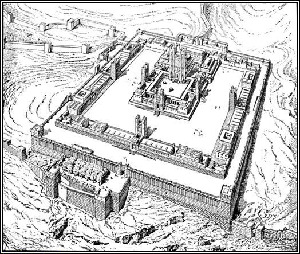
A drawing of Ezekiel's Visionary Temple from the Book of Ezekiel 40-47
* Third Temple: Since the destruction of the Second Temple in 70 CE, religious Jews have prayed that God will allow for the building of a Third Temple. This prayer has been a formal part of the traditional thrice daily Jewish prayer services. Though it remains unbuilt, the notion of and desire for a Third Temple is sacred in Judaism, particularly Orthodox Judaism, as an unrealized place of worship. The prophets in the Tanakh called for its construction, to be fulfilled in the Messianic era.
Unused ancient Jewish floor plans for a Temple exist in various sources, notably in Chapters 40-47 of Ezekiel (Ezekiel's vision pre-dates the Second Temple) and in the Temple Scroll discovered at Qumran among the Dead Sea Scrolls.
Divine Presence, is known as Shekhinah - alternative transliterations Shekinah, Shechinah, Shekina, Shechina, Schechinah, שכינה is the English spelling of a feminine Hebrew language word that means the dwelling or settling, and is used to denote the dwelling or settling presence of God, especially in the Temple in Jerusalem. Etymology: Shekhinah is derived from the Hebrew verb שכן. In Biblical Hebrew the word means literally to settle, inhabit, or dwell, and is used frequently in the Hebrew Bible. (See Exodus 40:35 - "Moses could not enter the Tent of Meeting, for the cloud rested [shakhan, the divine presence] upon it, and the glory of the Lord filled the Tabernacle." See also e.g. Genesis 9:27, 14:13, Psalms 37:3, Jeremiah 33:16, as well as the weekly Shabbat (welcoming in the
divine presence of heaven, with candle lighting, inner radiance, a light from within) blessing recited in the Temple in Jerusalem "May He who causes His name to dwell [shochan, the divine presence] in this House, cause to dwell among you love and brotherliness, peace and friendship"). In Mishnaic Hebrew the word is often used to refer to birds' nesting and nests. ("Every bird nests [shechinot, divine presence] with its kind, and man with its like, Talmud Baba Kammah 92b.) and can also mean "neighbor" ("If a neighbor and a scholar, the scholar is preferred" Talmud Ketubot 85b, the one who seeks is more divine). The word "Shekhinah" also means "royalty" or "royal residence" (our heaven, the perfection of love, the blue road, the heart) (The Greek word σκήνη - dwelling - is thought to be derived from שכינה and שכן.) The word for Tabernacle, mishcan, is a derivative of the same root and is also used in the sense of dwelling-place in the Bible, e.g. Psalm 132:5 ("Before I find a place for God, mishcanot (dwelling-places) for the Strong One(ness) of Israel.")(I must find the dwelling place, the rainbow colors, the holy temple which houses the soul, the heartbeat of heaven, my heart) Accordingly, in classic Jewish thought, the Shekhinah refers to a dwelling or settling in a special sense, a dwelling or settling of divine presence, to the effect that, while in proximity to the Shekhinah, the connection to God is more readily perceivable (again the divine presence of heaven, upon us, through prayer and worship of brotherly love, the golden rule). According to Professor Kern, Shekhinah means "the presence of God." practically the same as the Greek word "Parousia also a feminine word (literally: "presence") which is used in a similar way for "Divine Presence".
Shabbat or Shabbos (Hebrew: שבת, shabbāt, shabbes, "rest/inactivity"), is the weekly Sabbath or day of rest. Judaism, symbolizing the seventh day in Genesis in (mountain, I do stand, ready to command, my soul from heaven watches over the land, the rainbow colors, rest be still, listen receive God's will), after the six days of creation (That's the sacred blessings, the six days, the star of David, the perfect crystalline form. The six days are to build prayer to the winds, seven days, are to assemble, to commune and reflect upon.) Though it is commonly said to be the Saturday of each week, it is observed from sundown on Friday until the appearance of three stars in the sky on Saturday night. Shabbat is ushered in by lighting candles. (Candle-lighting to share our inner light) time changes from week to week and from place to place, depending on the time of the sunset at the location.
Etymology: The Hebrew word Shabbat comes from the Hebrew verb shavat, which literally means "to cease." Although Shabbat (or its anglicized version, "Sabbath") is almost universally translated as "rest" or a "period of rest," a more literal translation would be "ceasing", with the implication of "ceasing from work." Thus, Shabbat is the day of ceasing from work; while resting is implied, it is not a necessary denotation of the word itself. For example, the Hebrew word for "strike" (as in work stoppage) is shevita, which comes from the same Hebrew root as Shabbat, and has the same implication, namely that striking workers actively abstain from work, rather than passively.
Some people ask why God needed to "rest" on the seventh day of Creation according to Genesis. If the meaning of the word is understood as "ceasing from labor" rather than "rested," this is more consistent with the biblical view of an omnipotent God.
"When we cease walking in labor, we toil not, but live in joy, the divine presence of heaven, the soul, within does shine over living rivers of water. Let the stars shine, in the house of the throne, where kinsmen are known, and rainbow colors have come home," White Buffalo Calf Woman, your Twin Deer Mother.
In Islam, the site is revered as the location of Islamic prophet Muhammad’s journey to Jerusalem and ascent to heaven and is associated with other local Muslim figures of antiquity. The site is the location of the al-Aqsa mosque and the Dome of the Rock, the oldest extant Islamic structure in the world. Both Israel and the Palestinian Authority claim sovereignty over the site, which remains a key issue in the Arab-Israeli conflict. In 1967, the Israeli government assigned a Muslim council management of the site.)
According to classical Jewish belief, the Temple (or the Temple Mount) acts as the figurative "footstool" of God's presence (Heb. "shechina" in the physical world.") on Sukkot (1 Kings 8; 2 Chron. 7). And Sukkot was the first sacred occasion observed after the resumption of sacrifices in Jerusalem after the Babylonian captivity (Ezra 3:2-4).
In the time of Nehemiah, after the Babylonian captivity, the Israelites celebrated Sukkot by making and dwelling in booths, a practice of which Nehemiah reports: “the Israelites had not done so from the days of Joshua” (Neh. 8:13-17). In a practice related to that of the Four Species, Nehemiah also reports that the Israelites found in the Law the commandment that they “go out to the mountains and bring leafy branches
of olive trees, pine trees, myrtles, palms and [other] leafy trees to make booths” (Neh. 8:14-15). In Leviticus, God told Moses to command the people: “On the first day you shall take the product of hadar trees, branches of palm trees, boughs of leafy trees, and willows of the brook” (Lev. 23:40), and “You shall live in booths seven days; all citizens in Israel shall live in booths, in order that future generations may know that I made the Israelite people live in booths when I brought them out of the land of Egypt” (Lev. 23:42-43). Numbers, however, indicates that while in the wilderness, the Israelites dwelt in tents (Num. 11:10; 16:27).
Some secular scholars consider Leviticus 23:39-43 (the commandments regarding booths and the four species) to be an insertion by a late redactor. (E.g., Richard Elliott Friedman. The Bible with Sources Revealed, 228-29. New York: HarperSanFrancisco, 2003.)
Jeroboam son of Nebat, King of the northern Kingdom of Israel, whom Kings describes as practicing “his evil way” (1 Kings 13:33), celebrated a festival on the fifteenth day of the eighth month, one month after Sukkot, “in imitation of the festival in Judah” (1 Kings 12:32-33). “While Jeroboam was standing on the altar to present the offering, the man of God, at the command of the Lord, cried out against the altar” in disapproval (1 Kings 13:1).
According to Zechariah (Zech. 14:16-19), Sukkot in the messianic era will become a universal festival, and all nations will make pilgrimages annually to Jerusalem to celebrate the feast there. (A modern interpretation of this resulted in a recent holiday celebrated in Jerusalem by non-Jews, "The Feast of Tabernacles".) Sukkot is here associated with the granting of rain, an idea further developed in later Jewish literature. Observance of Sukkot is detailed in Mishnah, Tosefta, Jerusalem Talmud, and Babylonian Talmud in tractate Sukkah, part of the order Moed (Festivals). (Mishnah Sukkah 1:1–5:8; Tosefta Sukkah 1:1–4:28; Jerusalem Talmud Sukkah 1a–; Babylonian Talmud Sukkah 2a–56b.)
Sukkot in the Christian New Testament
Only in one place in the four Christian Gospels is there a mention of Sukkot. The Gospel of John mentions Sukkot indicating, "Now the Jews' feast of tabernacles was at hand." John 7:2 In this account, Jesus asks his own family to attend the feast telling them, "Go ye up unto this feast: I go not up yet unto this feast; for my time is not yet full come. When he had said these words unto them, he abode still in Galilee. But when his brethren were gone up, then went he also up unto the feast, not openly, but as it were, in secret. John 7:8-10.
Sukkot as a place
The name Sukkot appears in a number of places in the Hebrew Bible as a location:
- Sukkot is Egyptian for the "place of entering into the darkness". It's the place where the Sons of Israel went to retrieve the bones of Joseph from his tomb at Auaris before leaving Egypt. It is the first encampment of the Israelites after leaving Auaris (later named Pi-Ramesse/Raamses) (Exodus 12:37).
- Succoth is a city east of the Jordan River, identified with Tell Deir Άlla, a high mound, a mass of debris, in the plain north of Jabbok and about one mile from it (Josh. 13:27). This is where Jacob, on his return from Padan-aram after his interview with Esau, built a house for himself and made sukkot (booths) for his cattle (Gen. 32:17, 30; 33:17).
- The princes of Succoth (Sukkot) refused to provide help to Gideon and his men when they followed one of the bands of the fugitive Midianites after the great victory at Gilboa. After routing this band, Gideon on his return visited the rulers of the city with severe punishment. "He took the elders of the city, and thorns of the wilderness and briers, and with them he taught the men of Succoth" (Judg. 8:13-16). Wright identifies this with Deir Άlla.
- At this place were erected the foundries for casting the metal-work for the temple (1 Kings7:46). Thank you http://encyclopedia.thefreedictionary.com/sukkot
- Etymology of the name Auaris (Avaris)
Exodus Decoded, a made-for-TV documentary by Simcha Jacobovici [1] reported an unlikely etymology for the place name Avaris (Hatwaret/Auaris), suggesting the place name derives from the Hebrew word for "Hebrew" (Hebrew: עִבְרִי, Tiberian: ʕivɾi, Israeli: Ivri). If so, it would mean something like "the place of the Hebrews", and thus identify the Asiatic Hyksos with the biblical Hebrews. Nevertheless, while a Canaanite/Hebrew origin is plausible, it is difficult to show how the Canaanite/Hebrew word-root ʕ.b.ɾ (עבר), meaning "to pass" (whence a "Hebrew", a "passer-by", one who "goes across"), could linguistically become ħt wʕrt in Egyptian. The Hebrew to the word Ivri (Israelite) "עברי" has its roots in the words "מעבר הנהר" which translates as "from across the river". i.e. The Hebrew's or Israelites as such were commonly known as "those from across the river" (the Nile). Thank you http://encyclopedia.thefreedictionary.com/Avaris
- The stranger and the journey across the river! Give yee light. Brotherly love swells within a heart. Let us be kinsmen, to assist our travelers along the blue road of heaven, where the soul shines a light from within, to rise up to sing, and hearts do feel a spring in the air (a well). Water is blessed, we are in a sacred nest, all hearts belong together in the breeze. Welcome home, Sisters who reign/rain love! Thank you http://alightfromwithin.org
The Stranger: Deuteronomy 16
13 Thou shalt observe the Feast of Tabernacles seven days, after thou hast gathered in thy corn and thy wine.
14 And thou shalt rejoice in thy feast, thou, and thy son, and thy daughter, and thy manservant, and thy maidservant, and the Levite, the stranger, and the fatherless, and the widow, that are within thy gates.
Even if we're not native-born Israelis, or even Jewish, scripture says that even "the stranger within the gates" is to observe the Feast.
Restoration: Nehemiah 8
14 And they (Ezra and the scribes) found written in the law which the LORD had commanded by Moses, that the children of Israel should dwell in booths in the Feast of the seventh month:
15 And that they should publish and proclaim in all their cities, and in Jerusalem, saying, Go forth unto the mount, and fetch olive branches, and pine branches, and myrtle branches, and palm branches, and branches of thick trees, to make booths, as it is written.
16 So the people went forth, and brought them, and made themselves booths, every one upon the roof of his house, and in their courts, and in the courts of the house of God, and in the street of the water gate, and in the street of the gate of Ephraim.
Sukkot is also called The Feast, The Great Feast, Feast of Booths - Hag’ha Sukkot, Feast of Ingathering - Hag’Ha Asif, Time of Our Joy - Z’man Simchateinu, The Feast of Full Glory,
The Feast of the Watergate, The Festival of the Final Harvest. Thank you http://curtis.loftinnc.com/sukkot.htm